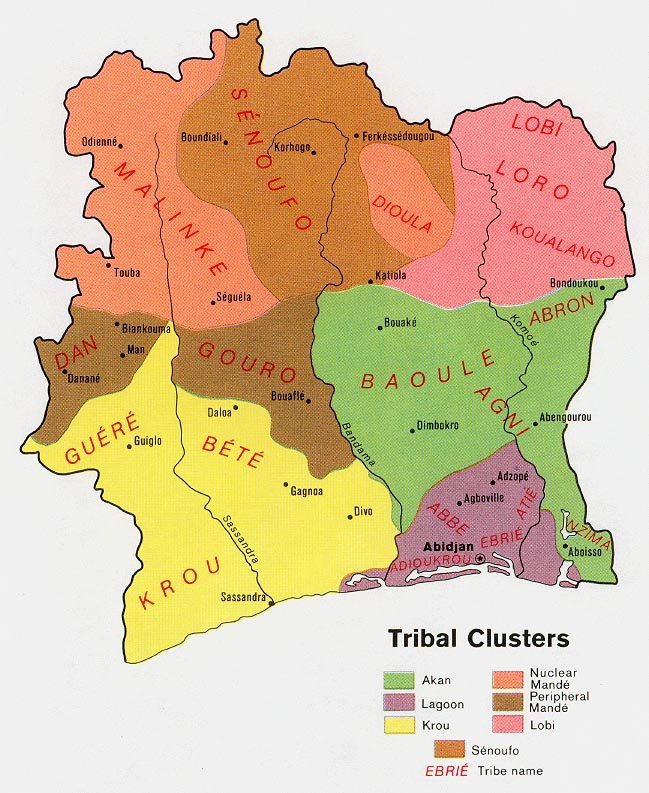
The Tiagbamrin Aizi are a small ethnic group living along the lagoon coastlands of southern Côte d'Ivoire, primarily in the Jacqueville department west of Abidjan. They are one of several Aizi subgroups — alongside the Aproum Aizi and Avikam — who together form the broader Aizi people cluster. The Tiagbamrin speak their own dialect of the Aizi language, a Kwa language of the Niger-Congo family, and have long maintained a distinct identity shaped by their relationship to the sea and lagoon systems that define their homeland.
Historically, the Aizi peoples were among the original inhabitants of the southern Ivorian coast. Their communities predate the colonial era and survived through fishing, trade along waterways, and close-knit village life. The Tiagbamrin have remained largely in their ancestral territory, relatively isolated from the rapid urbanization that has transformed much of coastal West Africa, though proximity to Abidjan means outside influences are never far away.
Life for the Tiagbamrin Aizi revolves around the water. Fishing is the backbone of the economy, and men spend long hours on the lagoon and Atlantic coast using traditional dugout canoes and nets. Women play a central role in processing and selling fish at local markets, and this trade is often the primary source of household income. Farming cassava, plantains, and other subsistence crops supplements what the water provides.
Family life is communal and extended, with multiple generations living near one another and elders commanding significant respect. Decisions — from marriage to land use — are often made collectively. Children grow up learning the rhythms of fishing from an early age, and there is a strong expectation that they will continue the traditional way of life. Education opportunities are limited in many villages, and children who pursue schooling often must travel to larger towns.
Celebrations tend to follow the agricultural and fishing seasons, honoring harvests and honoring the memory of ancestors. Music, dance, and communal feasting mark significant events such as births, marriages, and funerals. These gatherings reinforce the social bonds that hold Tiagbamrin communities together.
The Tiagbamrin Aizi practice a blend of traditional African religion alongside nominal Christianity. Animistic beliefs run deep — many people hold that spirits inhabit the lagoon, the forest, and the land, and that these forces must be respected and appeased to ensure good fishing, healthy families, and protection from harm. Ancestor veneration is a regular part of community life, with rituals performed to maintain harmony with those who have passed on.
While some among the Tiagbamrin identify as Christian, and churches may be present in the broader region, traditional practices remain deeply woven into daily life and often blend with Christian expression. Syncretism is common, meaning that many who call themselves Christians continue to participate in traditional ceremonies and rely on spiritual practitioners for healing and guidance. Evangelical Christianity has a limited presence among them, and a strong, indigenous gospel witness has yet to take root.
The Tiagbamrin Aizi face real physical hardships. Access to clean drinking water, adequate healthcare, and quality education remains limited in many of their lagoon-side villages. The fishing economy is vulnerable to environmental changes, including coastal erosion and declining fish stocks, which threaten food security and livelihoods. Infrastructure such as roads and electricity is often unreliable, making it difficult to access markets, medical facilities, or educational institutions.
Spiritually, the Tiagbamrin Aizi are in great need. Few, if any, have had a genuine opportunity to hear the gospel presented clearly in their heart language. The church, where present, often lacks discipleship depth and is easily blended with syncretistic practices. Workers equipped to minister cross-culturally among this people group are scarce, and Scripture resources in the Aizi language are minimal.
Pray that the Tiagbamrin Aizi will have access to Scripture and Christian resources translated into their language.
Pray for improved access to clean water, healthcare, and education in Tiagbamrin villages.
Pray that the Holy Spirit will send revival fire so that a vibrant, reproducing community of believers will emerge among the Tiagbamrin Aizi.
Pray for God to give them a record-high harvest of fish as a testimony of his power and goodness.
Scripture Prayers for the Aizi, Tiagbamrin in Côte d'Ivoire.
Ethnologue – Aizi Language
IMB People Groups – Côte d'Ivoire
World Christian Database – Aizi Cluster
| Profile Source: Joshua Project |